Holiday home insurance in France: the non-resident owner’s guide
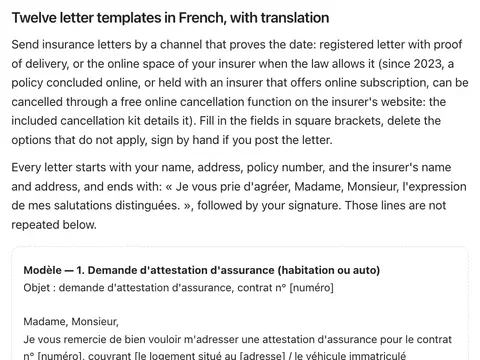
Complete pack · €89Insurance in France: the complete expat packTenant, owner, co-owner or holiday home: what to insure, how to let, how to claim, and the French letters you will need, translated
What’s in the pack — €89A French holiday home is insurable from anywhere — but not with a standard home policy read casually. The whole subject revolves around one word insurers care deeply about: unoccupancy.
Why « second home » changes the contract
A French multirisque habitation (see how MRH works) assumes someone lives there. Declare the property honestly as a résidence secondaire: premiums are similar or slightly higher, but the clauses differ. Most contracts reduce or suspend theft cover after 30 to 90 consecutive days of unoccupancy, and many impose duties for empty periods — shutting off water, winter drainage of pipes, frost-setting the heating, closing shutters. Breach a duty and the related claim can be cut or refused. If a neighbour or agency holds keys, declare it. Water damage is the statistically dominant claim in rarely-visited homes precisely because leaks run for weeks: a documented periodic visit is worth real money.
What a good policy includes
Fire, water damage, storm and the French state-backed natural-disaster regime (automatic in every property policy, financed by a uniform surcharge, with a legal deductible no contract can waive — relevant for flood-prone river and coastal properties). Declare everything on the plot: swimming pool and its equipment, outbuildings, garden furniture — each typically carries its own ceiling. Contents follow the usual French logic: undervaluation triggers proportional reduction of any claim. Expect roughly €15-50/month for a typical holiday house, more with pool and high-value contents.
Letting it out
Occasional holiday letting (Airbnb-style) must be declared: the standard mechanism is a clause covering the owner while tenants occupy, combined with the tenant’s own liability — platform « host guarantees » are goodwill programmes, not insurance. If the property is let long-term instead, the right product is the landlord’s PNO policy (propriétaire non occupant). Our French pages detail both setups: location saisonnière and assurance du propriétaire non-résident.
Buying and managing from abroad
Non-residents can subscribe without French residency; SEPA direct debit from most European accounts works, and several insurers handle everything online. Time the start date to the notaire’s deed: the buyer bears the risk from signature day, and the notaire will ask for proof of insurance. If a French mortgage finances the purchase, the bank will also make borrower insurance a condition of the loan: our guide to borrower insurance for an expat mortgage explains how to choose and switch it from abroad. Keep the insurer’s correspondence address current — a formal notice sent to an unread French letterbox still produces legal effects. A boat kept in a nearby marina is a separate contract, never part of the house policy: see our boat insurance guide for non-resident owners. For the wider picture of what is mandatory in France, start with our overview of French insurance.
Sources
Updated 8 October 2026.
More expat guides: Landlord insurance in France: the PNO policy explained · Business insurance in France: what is mandatory, what is wise · Tenant insurance in France: the policy your landlord will demand · Buying and insuring a car in France: the expat’s checklist · all guides.