Caravan insurance in France: touring, storage and the 750 kg rule
Practical kit · €24Motorhome, campervan and caravan insurance in France kitThe licence for each weight, VASP registration, a grid to read French policies, winter lay-up, renting out, claims and 8 French letters translated
See the kit — €24Short answer: caravan insurance in France costs roughly €8–35 per month in 2026 — the indicative range on our French assurance caravane page, where value, use and the exposure of the pitch decide where you land. Up to 750 kg gross weight, the towing car’s liability usually covers the caravan on the road; above that, it must be declared to your insurer or insured on its own. In every case, damage to the caravan itself needs a dedicated policy.
Caravans occupy a blind spot of French motor insurance: they have no engine, yet they live on the road — or on a campsite pitch for years. The rules that apply depend on one number: the caravan’s gross laden weight (PTAC on French papers). Get that distinction right and everything else follows.
The 750 kg rule: when your car policy is enough
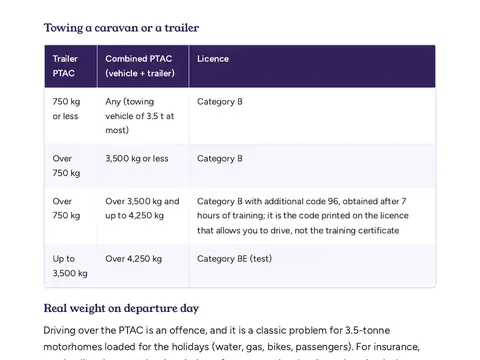
While being towed, a caravan of 750 kg gross weight or less is generally covered by the towing car’s third-party liability automatically — most French car policies extend liability to light trailers, but the clause varies, so check yours and declare the caravan if the contract asks for it. Above 750 kg, the caravan must be declared to your insurer or insured under a dedicated policy. Registration follows a lower threshold: any trailer over 500 kg gross weight carries its own registration (carte grise) and its own number plate. Either way, one thing never changes: the car’s liability only pays for damage the caravan causes to others. Damage to the caravan itself — a jack-knife on the motorway, hail through the roof, theft from a pitch — is only covered by a dedicated caravan policy. Motorway loss-of-control is not a rare fluke: the self-sustaining sway of a car–caravan combination (« snaking ») is a long-studied engineering problem (Sharp & Fernández, 2002), and crosswind is analysed as one of its triggers (Mantriota, 2005). Only damage cover pays for the caravan when it happens.
What a dedicated caravan policy adds
A proper policy stacks four blocks on top of liability. Damage cover for the shell, including while manoeuvring by hand — a classic and surprisingly expensive claim. Contents cover with its own ceiling and burglary conditions (forced entry, sometimes an approved hitch lock or wheel clamp). Storm and natural events — the single most important line for a caravan, which is light, tall and often parked in the open; France’s regulated natural-disaster regime (catastrophes naturelles) applies here as it does to homes. And theft of the caravan itself, usually conditional on an approved hitch lock. Budget roughly €8–35 per month depending on value and use — modest next to the premiums covered in our motorhome guide, the campervan guide and on the motorhome hub.
Static caravan insurance in France: a different risk altogether
A caravan that stays on a campsite pitch year-round is no longer a road risk: it is a small dwelling exposed to storm, theft and neighbour liability. Insurers price it accordingly — some under caravan policies with a « résidence » clause, others under products close to the mobile-home cover described on our French mobil-home page. Tell the insurer the caravan is static: premiums are often lower than touring cover, but an undeclared permanent pitch is exactly the kind of inaccuracy that shrinks a storm claim. Campsites also routinely require proof of liability insurance at check-in — the attestation is standard French practice, as for home insurance.
Getting a quote: the five facts insurers ask
A French caravan quote turns on five answers, so have them ready: the gross laden weight (PTAC, printed on the carte grise or the maker’s plate); the use — touring, seasonal or parked year-round on a pitch; the value of the caravan and its equipment (awning, motor mover); the region and exposure of where it is kept, storm and hail first; and winter storage — yard, driveway or pitch, with or without tie-downs. Many contracts make tie-downs out of season a condition of storm cover. To receive up to 3 proposals, use the request form on our French caravane page: email required, phone optional, form in French. Claude Assur is an information site, not a broker — no policy is sold here, insurers answer you directly.
Bringing a foreign caravan to France
For holidays, your home-country policy travels with you: EU (and UK) car policies include EU-wide third-party liability, and UK caravan policies generally extend to continental trips — check the number of days covered abroad and whether contents and storm cover apply outside the UK, not just liability. If you become a French resident, the caravan follows the same logic as a car: French registration (for caravans over 750 kg) and a French policy. Our guide to foreign-registered vehicles in France details the residency mechanics.
Frequently asked questions
How much does caravan insurance cost in France?
Indicatively €8–35 per month in 2026. The low end is liability plus basic damage on a modest tourer kept in a yard; the high end is a recent caravan with contents, theft and storm cover, or a static caravan on an exposed pitch. Only an insurer’s quote gives the real price.
Does my caravan need its own insurance in France?
Over 750 kg gross weight: yes in practice — a declaration to your insurer or a dedicated policy (and, above 500 kg, its own registration and plate). At or under 750 kg: the towing car’s liability usually extends to it, but damage to the caravan itself and its contents is never covered without a dedicated policy.
Is my caravan covered on a campsite over winter?
Only if the policy says so: touring policies vary on out-of-season storage, and storm damage on an exposed pitch is the most frequent winter claim. Declare where the caravan actually winters — a locked storage yard, your driveway or a coastal pitch are three different prices, and the honest declaration is what makes the claim payable.
Is static caravan insurance in France cheaper than touring cover?
Often, because the road risk disappears — but the storm and theft risk of a pitch occupied all year replaces it. Declare the caravan as static, along with its awning, decking and shed: those additions are what the first storm takes, and undeclared ones may not be indemnified.
Can I insure a caravan in France as a non-resident?
Generally yes: French insurers underwrite the address where the caravan is kept — a French address for the risk — rather than your nationality or tax residency. Second-home owners commonly insure a caravan kept at their French property or on a permanent pitch; expect questions about storage and usage, and compare among insurers used to non-resident owners.
Sources
Updated 13 October 2026.
More expat guides: Young driver car insurance in France: the novice surcharge explained · Furnished rental insurance in France: tenant and landlord sides · Campervan insurance in France: the foreigner’s guide to vans and conversions · Boat insurance in France: the expat owner’s guide · all guides.