Motorhome insurance in France: the touring owner’s guide
Practical kit · €24Motorhome, campervan and caravan insurance in France kitThe licence for each weight, VASP registration, a grid to read French policies, winter lay-up, renting out, claims and 8 French letters translated
See the kit — €24Short answer: a motorhome in France must always carry third-party liability insurance, even parked between trips, as long as it is able to move; most owners add theft, fire and contents cover, for roughly €25–90 a month depending on the vehicle’s value, the cover and how much it is used. Towing a caravan instead? It follows trailer rules, explained in our caravan insurance guide.
France is Europe’s biggest motorhome market and arguably its best touring country — and its insurance rules treat your vehicle-home with the same seriousness as any car. Here is what owners, buyers and visiting tourers need to know, whether the vehicle is French-registered or you are bringing your own.
The legal core: a motorhome is a vehicle
Third-party liability (responsabilité civile) is compulsory for any motorhome or campervan in France, even one parked on your own land between trips — the obligation attaches to the vehicle, not to its use. On top of that legal floor, formulas mirror car insurance: third-party extended (theft, fire, glass) or comprehensive, plus motorhome-specific blocks. Budget roughly €25–90 per month depending on value, cover and use; heavier vehicles over 3.5 tonnes need insurers used to that segment (our French page on camping-cars poids lourds details it). For the general mechanics of French vehicle cover — the bonus-malus, claims statements, formulas — see the car insurance guide and the motorhome insurance hub.
Contents, fittings and conversions: where motorhome policies are won
The lines that separate a good policy from a cheap one are rarely about driving. Contents (bedding, bikes, electronics) carry their own ceiling and burglary conditions — forced entry, sometimes an alarm or approved lock. Fittings — solar panels, awnings, satellite dishes, lithium batteries — must be declared, ideally with invoices, or the claim shrinks to the bare vehicle. Self-converted vans deserve special honesty: describe the conversion (photos, invoices), and consider re-registering a permanent conversion as VASP — the full picture for vans is in our campervan insurance guide, with French specifics on the van aménagé page. Breakdown assistance is the other differentiator: check the towing weight limit actually matches your vehicle, and whether accommodation is covered while your rolling home is in the workshop.
Caravans and trailers: separate rules
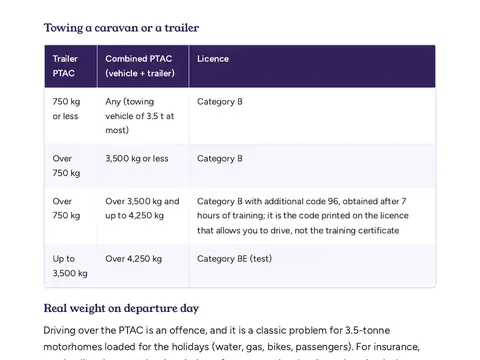
A towed caravan follows trailer logic. Under 750 kg gross weight, your car policy’s liability usually extends to it automatically — check the clause. Over 750 kg, the caravan must be declared to, or separately insured with, your insurer (own registration already applies above 500 kg); damage to the caravan itself and its contents is never covered by the towing car’s liability, only by a dedicated caravan policy. The full picture — registration, static caravans, foreign tourers — is in our dedicated caravan insurance guide, with French practicalities on the assurance caravane page. Note that a caravan stored on a pitch year-round shifts the risk from road to storm and theft — say so, the premium follows the real risk.
Wintering, storage and part-year use
Most French motorhomes sleep several months a year, and contracts have learned to price it: mileage-based formulas, or clauses suspending driving-related cover during declared storage while keeping fire, theft and natural-disaster protection. Storage conditions matter — a locked hangar is priced differently from a street corner. What you may not do is cancel insurance entirely over winter: the liability obligation applies to any vehicle able to move. Our French page on hivernage covers the seasonal mechanics.
Roadworthiness test: a motorhome is tested like a car
Service-public.fr classes a motorhome of up to 3.5 tonnes with passenger cars (category M1): its first contrôle technique falls in the six months before the fourth anniversary of its first registration, and a favourable result is then valid for 2 years. No reminder is sent. Motorhomes over 3.5 tonnes are subject to periodic testing too, under a separate regime.
Frequently asked questions
Can I tour France with my foreign-insured motorhome?
Yes: EU and UK policies include EU-wide third-party liability (UK insurers no longer need green cards for the EU, but check your certificate covers the whole trip duration and comprehensive cover abroad, not just liability). Once you become a French resident and register the vehicle in France, you need a French policy.
Is my motorhome insured while parked at home between trips?
Liability must remain in force — that is the law. Theft, fire and storm cover depend on your formula and declared parking; if the vehicle winters on your driveway rather than the locked garage you declared, a claim can be reduced. Declare the real storage place.
Can I insure a motorhome in France as a non-resident?
Insurers require a French address for the risk — where the vehicle is registered and normally kept — rather than French citizenship. Second-home owners keeping a French-registered motorhome at their French property are a known profile; several insurers accept it with questions about storage and who drives. A vehicle genuinely based abroad, by contrast, belongs with an insurer in its home country.
Sources
Updated 21 October 2026.
More expat guides: Classic car insurance in France: collector status, agreed value · Driving a UK or foreign-plated car in France: insurance rules · Motorbike and scooter insurance in France: the rider’s guide · Caravan insurance in France: touring, storage and the 750 kg rule · all guides.