Breakdown cover in France: it is already in your car policy
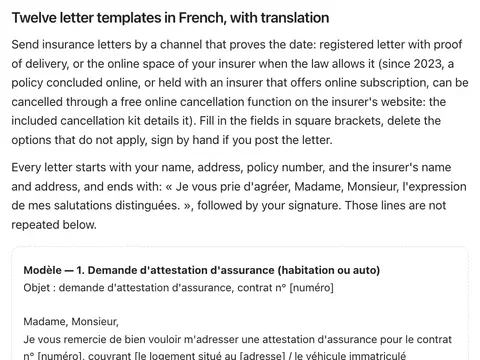
Complete pack · €89Insurance in France: the complete expat packYour licence, registration and foreign no-claims record, the accident report translated box by box, and the French letters to your insurer
What’s in the pack — €89Drivers arriving from the UK, Ireland or the Netherlands look for the French equivalent of the AA or the ANWB and do not really find one. France works differently: roadside assistance is a block inside your motor insurance policy, operated on the insurer's behalf by an assisteur — a specialised assistance company reachable around the clock. Standalone memberships exist, sold by motoring clubs and by manufacturers with new cars, but the default is that you already have cover and simply do not know its limits.
The number that decides everything: the kilometre franchise
French assistance clauses are written as « assistance à partir de X km du domicile ». Below that distance, nothing is owed. Entry-level policies commonly start at 25 or 50 km, which sounds harmless until you remember that a large share of breakdowns — flat battery, flat tyre, keys locked inside — happen at home or in the street outside it. Cover described as « 0 km » starts on your own driveway. The upgrade usually costs a few euros a month and is, line for line, the best value in a French motor policy. Check it on your conditions particulières before you need it.
What the block actually contains
Roadside repair or towing to the nearest approved garage; taxi or onward travel for the occupants; a replacement vehicle, typically for three to five days and in a lower category than your own; hotel accommodation if you are stranded far from home; and return of the repaired vehicle. Two limits recur: the replacement car is often excluded for a simple breakdown on cheap policies and granted only after an accident, and the tow is to the nearest garage, not to your preferred one. Extras vary widely — running out of fuel, using the wrong fuel, losing the keys and, increasingly relevant, running an electric car flat are covered by some contracts and excluded by others. Electric-vehicle owners should read that clause specifically: an empty battery is treated by several insurers as a driver error rather than a breakdown.
Motorways: you cannot call your own insurer
This is the French rule that surprises everyone, and it is not negotiable. On motorways and expressways, breakdown recovery is a public-safety monopoly: only operators approved for that stretch may intervene. You must call for help using an orange emergency phone at the roadside — they stand every two kilometres and locate you automatically — or dial 112, and the approved operator is dispatched. Your assisteur cannot send its own truck onto the motorway, and a private tow arriving from outside will be turned away.
The intervention is billed at a nationally regulated flat rate, revised each year by ministerial order and identical for every approved operator, with a supplement at night, at weekends and on public holidays. You pay the operator on the spot, then send the invoice to your assisteur for reimbursement within the policy limits. Practical consequence: call your assistance number anyway, immediately after the emergency phone, so that the file is opened and the onward travel, replacement car and hotel are organised — and so that the reimbursement is not contested later.
Safety first, and it is enforced
Every vehicle registered in France must carry a high-visibility jacket within reach of the driver — inside the cabin, not in the boot — and a warning triangle. Put the jacket on before leaving the car, place the triangle at least thirty metres behind, and wait behind the safety barrier rather than in the vehicle. On a motorway hard shoulder this is a survival instruction rather than an administrative one, and the fine for the missing jacket is a fixed penalty.
Beyond the car
The same logic applies elsewhere. Motorcycle policies carry their own assistance block, where the kilometre franchise matters even more and where the tow must be able to take a bike — see our motorbike insurance guide. Motorhomes need assistance rated for their weight and height, and a replacement vehicle clause that means something for a family on holiday: our motorhome guide and campervan guide cover it. Home policies include their own assistance for emergency locksmiths and plumbers. And when the incident happens abroad, or involves your health rather than the vehicle, the relevant cover is medical assistance and repatriation, explained in our French guide on assistance et rapatriement.
Frequently asked questions
Do I need to buy separate breakdown cover in France?
Usually not. Check your motor policy first: the assistance block is nearly always there, and the useful question is the kilometre franchise and whether a replacement vehicle is included for breakdowns. Upgrading the existing clause is almost always cheaper than a standalone membership; when you ask for a new car insurance quote, have the assistance block quoted separately.
Does French assistance cover me elsewhere in Europe?
Most policies extend assistance to the countries listed on the insurance certificate, typically the EU and several neighbouring states, with a mileage or duration limit and repatriation of the vehicle if it cannot be repaired within a set number of days. Confirm the list and the limits before a long trip rather than at the border.
What do I do if I break down on a motorway?
Pull onto the hard shoulder, put on the high-visibility jacket, get everyone out on the verge side and behind the barrier, then use the nearest orange emergency phone or call 112. Only approved operators may intervene there. Pay the regulated tariff, keep the invoice, and call your assistance number to open the claim and arrange onward travel.
Is a replacement car included?
Not automatically. Entry-level contracts often grant one only after an accident, and for three to five days in a smaller category. If your daily life depends on the car, this clause deserves more attention than the headline premium — our car insurance guide explains where it sits in the policy.
Sources
Updated 25 August 2026.
More expat guides: Insurance in France: the expat’s map · Car insurance in France: the expat mechanics · Home insurance in France: tenant duty, owner wisdom · Health cover in France: sécu + mutuelle, decoded · all guides.