Complete expat pack · updated 2026
Insurance in France: the complete pack for English speakers
Who it is for: Britons, Americans, Irish, Dutch and other English speakers moving to France or already living there
- 13chapters
- 12French letters, translated
- 44checklist items
- 10tables
- 7links to the official texts
Checked before every release
Reviewed by industry professionals
- 38automated testsrun at every release: prices, links, pages and content checked before publication.
- 38links to the textsevery rule and deadline linked to the official French text.
- 23 October 2026last updaterules checked on this date; you always read the latest version.
Built from the texts and data of Service-public.fr, Légifrance, La Médiation de l’assurance, EUR-Lex, ANTS, Assurance Maladie (ameli.fr).
€89VAT included · one payment · instant access
A 13-chapter guide in plain English (car, home, health, claims and letting explained, 12 French letters translated, and 6 kits included). €89, VAT included, one payment, instant access, printable to PDF, invoice by email. The 6 kits inside cost €90 bought separately: the guide and its letters come on top.
Get the complete pack — €89 Read chapter 1 free
As described, or refunded · updates included, at no cost · terms of sale
Secure payment by Stripe · Apple Pay · Instant access, no subscription
You pay → instant access + receipt by email → findable at any time (Find my purchases) · Questions: admin@tech-bharat.com
What you get
- A 13-chapter guide in plain English: car, home, health, motorhome and boat, claims, letting
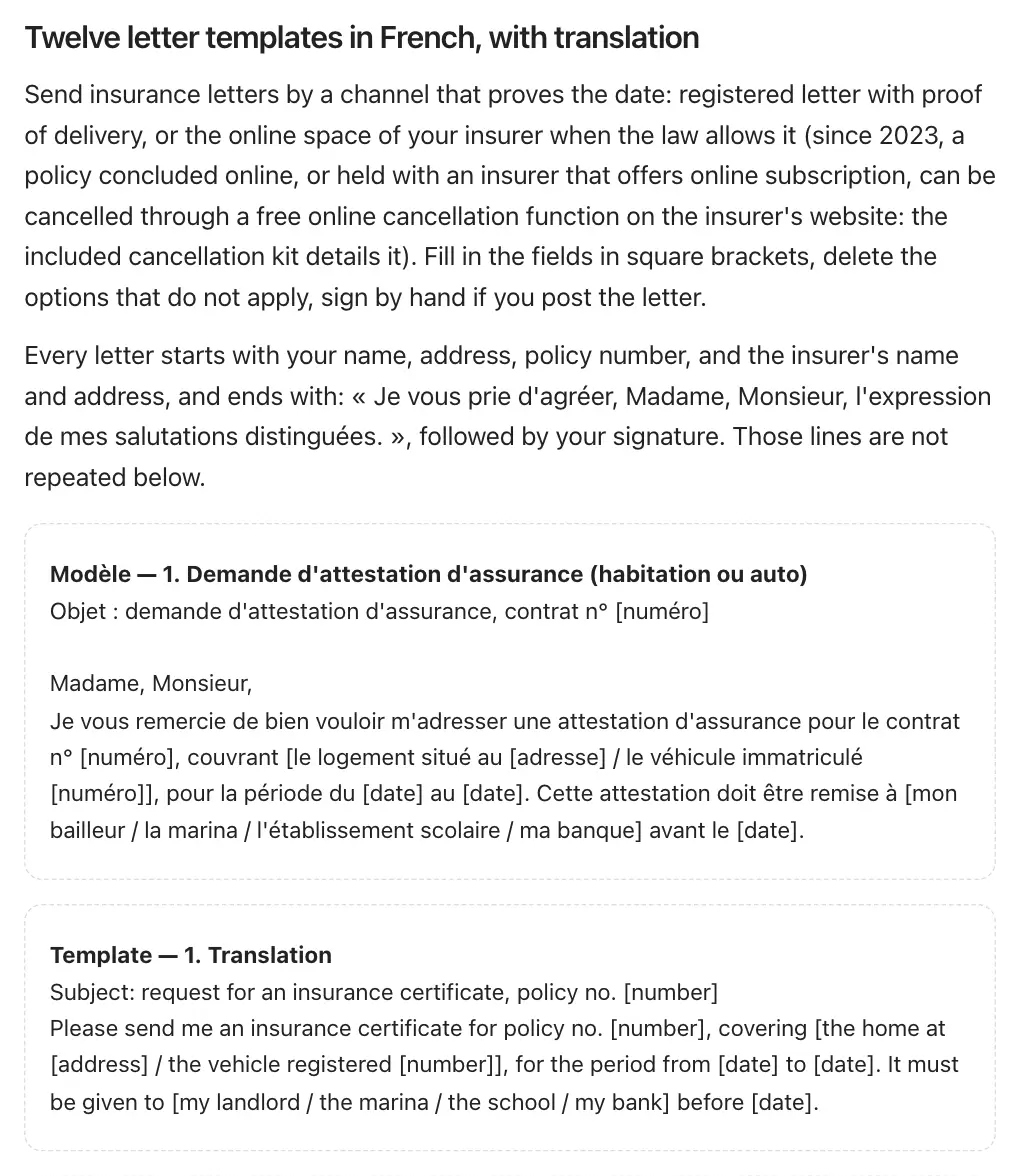
- 12 letter templates in French, each translated into English
- The accident report translated box by box, a glossary and a yearly calendar
- 6 kits included: cancellation, no-claims bonus, mortgage insurance, motorhome and caravan, motorbike, dog and cat (€90 separately)
Everything you need to insure your car, home, health and holiday home in France, handle a claim and deal with French insurers in their own language.
Who it is for
- Britons, Americans, Irish, Dutch and other English speakers moving to France or already living there
- Owners of a French holiday home who live abroad and manage it from a distance
- Expats who drive in France, with a French or foreign registration, a car, a motorbike, a motorhome or a caravan
- Anyone facing a claim or a renewal letter in French and wanting to understand exactly what to do
What is inside, chapter by chapter
- The ten rules every newcomer to French insurance should know (free extract below)
- Your arrival plan: what to insure, in what order
- Driving in France: licence, registration, cover and your foreign record
- The accident report (constat amiable), box by box
- Your home: tenant, owner, co-owner and holiday home
- Health: Assurance Maladie, carte Vitale and the mutuelle
- Motorhome, campervan, caravan and boat
- When something goes wrong: declaring, valuing and contesting a claim
- Letting your property: landlord insurance, the tenant's certificate and unpaid rent
- Changing, cancelling and leaving France
- French-English insurance glossary
- Twelve letter templates in French, with translation
- Your insurance file and yearly calendar
What you get
- The complete guide: 13 chapters, about 9900 words (12 letter templates, 44 checklist items, 10 tables)
- Included: Cancelling insurance in France kit (Hamon, Chatel, health…), in English and in French (9 chapters)
- Included: French no-claims bonus and claims record kit, in English and in French (9 chapters)
- Included: Switching your mortgage insurance in France (Lemoine law) kit, in English and in French (8 chapters)
- Included: Motorhome, campervan and caravan insurance in France kit, in English and in French (10 chapters)
- Included: Motorbike and scooter insurance in France kit, in English and in French (11 chapters)
- Included: Dog and cat insurance in France kit, in English and in French (10 chapters)
The 6 included kits are sold separately: €90 in total.
Introduction
France runs on insurance certificates. You need one to rent a flat, to register a car, to get a mooring for a boat, to enrol a child at school, to sign the lease of a holiday home and often to get a mortgage. The rules are written in the French Insurance Code (code des assurances), the contracts are in French, the letters must be in French, and the deadlines are short. This pack gives you the whole system in English, organised by what you actually have to do.
It is built in three layers. The chapters explain each area (driving, home, health, leisure vehicles, claims, letting, changing policy) with the rule, the deadline and the trap. The tools come next: a French-English glossary of the words you will find in your contracts, a box-by-box translation of the French accident report, twelve letter templates in French with an English translation, and an annual checklist. Finally, the pack includes six specialised kits in English and French: cancelling a policy (Hamon, Chatel, moving, selling a car), the no-claims bonus and claims record, switching mortgage insurance (Lemoine law), and, since 23 October 2026, motorhome, campervan and caravan insurance, motorbike and scooter insurance, and dog and cat insurance. Their links are on your access page, after the last chapter.
Read chapter 1 first, then go straight to the chapter that matches your situation; the arrival table in chapter 2 tells you which ones.
The ten rules every newcomer to French insurance should know
These ten rules explain most of the surprises English speakers meet in their first year. Each one is developed later in the pack.
1. Some cover is compulsory, and the law says so
Three insurances are compulsory for private individuals in everyday life: third-party liability for any motor vehicle that can be driven on the road, even if it stays in a garage (article L211-1 of the Insurance Code); tenant liability insurance for anyone renting an unfurnished main home (article 7 g of the law of 6 July 1989); and civil liability for every co-owner of a flat in a building under co-ownership, whether they live in it or let it (article 9-1 of the law of 10 July 1965). Health cover through the state scheme is not a contract you buy: it comes with residence or work (chapter 6). Everything else, including the mutuelle, home insurance for an owner of a house, and boat insurance, is legally optional but often demanded in practice by a lender, a landlord, a marina or an employer.
2. The contract renews itself every year
French personal policies are renewed tacitly at each anniversary (tacite reconduction). Nobody asks you whether you want to continue. To leave, you use one of the legal exits: the anniversary with two months' notice, the Chatel rule when the insurer's reminder is late, the Hamon rule after one year, a change of situation such as moving abroad. Our cancellation kit, included in this pack, gives the decision table and the letters.
3. The premium is set by what you declare
When you take out a policy you answer a questionnaire. A false or incomplete answer, even in good faith, can reduce the payout in proportion to the premium you should have paid (article L113-9); an intentional false statement can void the contract (article L113-8). Translate every question before you answer it; the glossary in chapter 11 helps. Tell the insurer during the contract when something it asked about changes: a new driver, a swimming pool, a holiday home that is now let.
4. Your car's bonus belongs to you, not to the car
The French no-claims system, the coefficient de réduction-majoration (CRM, or bonus-malus), is the same formula at every insurer: minus 5 % a year without an at-fault claim, down to a floor of 0.50; plus 25 % for each at-fault claim, up to a ceiling of 3.50. It follows the named driver from car to car and from insurer to insurer, and it is proved by a document called the relevé d'information. Our no-claims kit, included in this pack, explains how to have a foreign driving history taken into account.
5. The French plate is now the proof of insurance
Since 1 April 2024, cars registered in France no longer carry a green card or a windscreen sticker: the police check a central file of insured vehicles. Insurers give you a "memo" document instead, which you should still keep in the car because it carries your policy number, useful after an accident.
6. You must declare a loss quickly
The Insurance Code sets minimum notice periods that a policy can lengthen but never shorten (article L113-2): five working days for most claims, two working days for a theft, and for a natural disaster thirty days after the government decree recognising it is published. Late notice can cost you the payout if the insurer shows it was harmed by the delay. Chapter 8 gives the method.
7. Two years to act, not six
Claims and disputes arising from an insurance contract are time-barred after two years (article L114-1), not the six years many English speakers expect. The clock starts at the event that gives rise to the claim, and it can be interrupted, for example by a registered letter about the payout or by the appointment of an expert (article L114-2).
8. Insurers, agents and brokers are different people
An assureur carries the risk. An agent général represents one insurer. A courtier (broker) works for you and can compare several insurers. All intermediaries must be registered with ORIAS, and you can check them on the ORIAS register. A mutuelle is a non-profit health insurer governed by the Mutual Code, but for you it works like an insurer.
9. There is a free mediator
When a complaint to your insurer's customer service and then its complaints department fails, you can refer the dispute free of charge to the insurance ombudsman, La Médiation de l'Assurance, or to the mediator named in your contract. The ombudsman will not consider a case before you have complained to the insurer in writing. Letter 9 in chapter 12 is the referral.
10. French is the language that counts
Your contract, the conditions générales and conditions particulières, is in French and that text is binding. Some insurers provide an English summary or an English-speaking helpline; it is a courtesy, never the contract. Always keep the French documents and send your letters in French: chapter 12 gives you twelve letters with their translation, so you know exactly what you sign.
Free guides or the pack
The free guides explain the rules. The kit gets it done: the steps in order, the deadlines and the letters.
Free guides
€0
free on this site
- ✓The rules explained, official texts cited
- —The steps in order, with the deadlines
- —12 French letters with their translation
- —44 checklist items
- —Bookmark it or print it to PDF
Complete expat pack
€89
VAT included, paid once
- ✓The rules explained, official texts cited
- ✓The steps in order, with the deadlines
- ✓12 French letters with their translation
- ✓44 checklist items
- ✓Bookmark it or print it to PDF
As described, or refunded · updates included, at no cost
Checkout by Stripe
Card or Apple Pay on Stripe’s secure page. Your card details never go through our servers.
Instant access
The complete pack opens right after payment, to bookmark or save as a PDF. Receipt and invoice by email.
VAT included, paid once
The price shown is the total. No subscription, nothing charged later.
Sources you can check
7 links to the official French texts (Légifrance, Service-public…). Not an insurer, not a broker: the kit explains the rules and sells no policy. Terms of sale.
Frequently asked questions
How do I receive the kit?
Right after payment, the confirmation page gives you the link to the complete kit, also sent by email. Bookmark the kit page or print it to PDF (Ctrl+P or Cmd+P, “Save as PDF”). Stripe also emails you the receipt.
Do I get an invoice?
Yes: Stripe generates the invoice and emails it to you.
Is the payment secure?
Yes: you pay once on our checkout page secured by Stripe, with no subscription. Your card details never go through our servers.
What is the guarantee?
The kit is guaranteed as described: if access fails or the content does not match, we restore your access or refund you (terms of sale). It is updated at no cost when the rules change. Contact: admin@tech-bharat.com.
Who publishes the kit?
Claude Assur, an independent information publisher, not an insurer, a broker or a lawyer: the kit explains the general rules and gives you the method and templates; only the official texts and your policy are authoritative.
Other kits
Self-employed kit
Business insurance for the self-employed in France kit
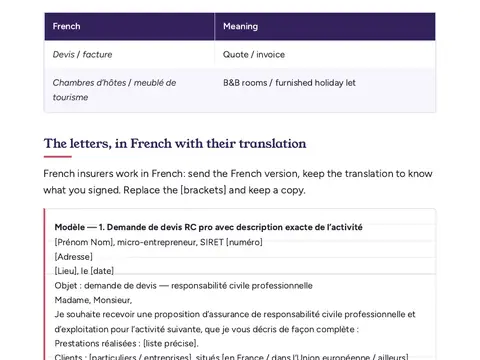
What is compulsory for your trade, the décennale, quote and invoice wording, gîtes and B&Bs, and 7 French letters translated.
€24 13 chapters · instant access
See the kit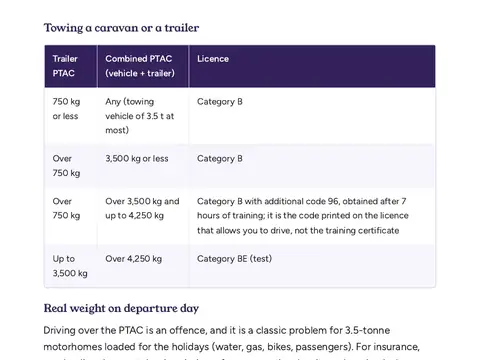
Motorhome kit
Motorhome, campervan and caravan insurance in France kit
The licence for each weight, VASP registration, a grid to read French policies, winter lay-up, renting out, claims and 8 French letters translated.
€24 10 chapters · instant access
See the kit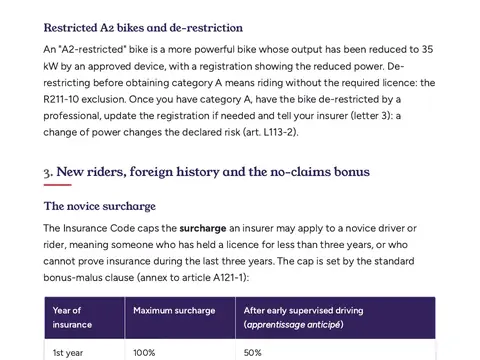
Motorbike kit
Motorbike and scooter insurance in France kit
Licence categories, your foreign history, the novice surcharge, rider cover, compulsory gloves, theft clauses, accidents and 8 French letters translated.
€19 11 chapters · instant access
See the kit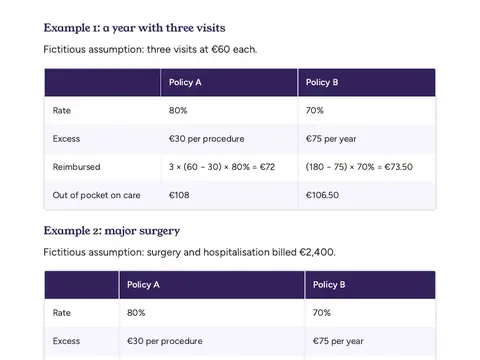
Dog and cat kit
Dog and cat insurance in France kit
The six figures of a French pet policy, a comparison grid, your out-of-pocket cost, breed exclusions, owner rules, claims and 8 French letters translated.
€19 10 chapters · instant access
See the kit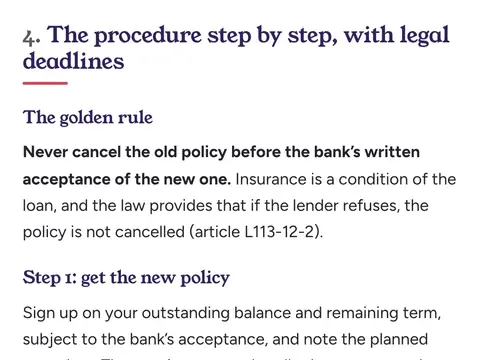
Lemoine law kit
Switching your mortgage insurance in France (Lemoine law) kit
Savings calculation, equivalent cover, step-by-step process and ready-to-send letters.
€12 8 chapters · instant access
See the kit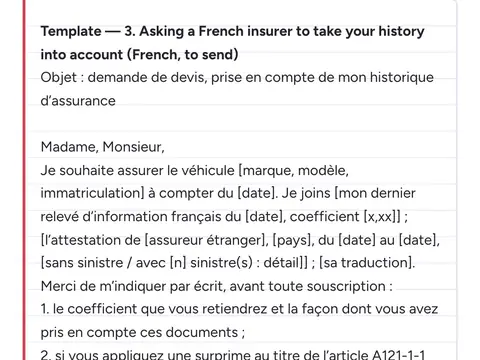
No-claims kit
French no-claims bonus and claims record kit
Work out your coefficient, get your French claims record, use your foreign no-claims, letter templates.
€9 9 chapters · instant access
See the kit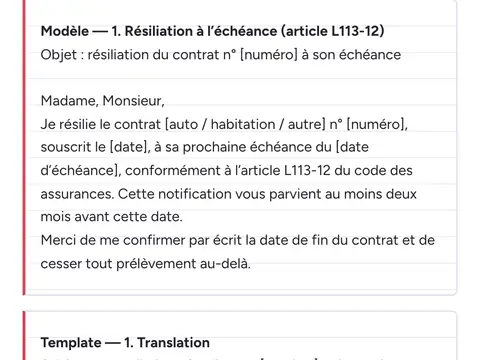
Cancellation kit
Cancelling insurance in France kit (Hamon, Chatel, health…)
Which rule applies to your policy, which notice period, and the ready-to-send letter.
€7 9 chapters · instant access
See the kitInstant access to your kit after payment · price VAT included · terms of sale. Claude Assur is not an insurer, a broker, a registered insurance intermediary (ORIAS) or a lawyer: the kits explain the general rules and are not personal advice; only the official texts and your own policy are authoritative.