Student insurance in France: the three certificates you will be asked for
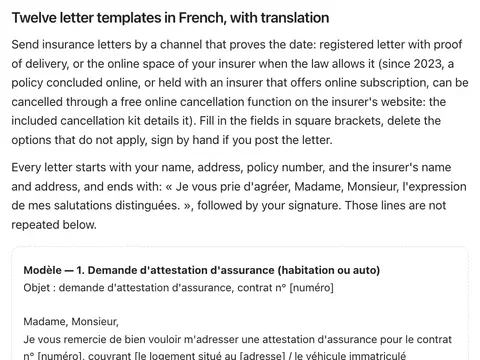
Complete pack · €89Insurance in France: the complete expat packAssurance Maladie, the carte Vitale and the mutuelle in plain English, plus the French letters you will need, translated
What’s in the pack — €89Arriving as a student in France means being asked for paperwork by three different people in the same fortnight: the university wants a responsabilité civile certificate, the landlord wants a home insurance certificate before handing over the keys, and the health system wants you registered before it reimburses anything. None of these is expensive. All three catch newcomers out, because in most countries they simply do not exist as separate documents.
Health: registration first, mutuelle second
Since 2019 there is no longer a student health regime in France. Students join the ordinary general scheme, and cover is handled by the local CPAM like any other resident. If you are an EU, EEA or Swiss student on a temporary exchange, your European Health Insurance Card from home is normally enough for the duration of your studies, and you do not need to register in France at all. If you come from outside the EU, or you settle in France long term, you register online with the Assurance Maladie through the dedicated portal for international students — it is free, it takes a few weeks, and you receive a provisional social security number before the carte Vitale itself.
State cover reimburses roughly 70% of a standard GP consultation and much less on dental and optical work, which is why almost everyone adds a mutuelle — the top-up described in our French health insurance guide. Student-oriented policies start around €10-25 a month; the cheapest tiers barely improve dental and optical cover, so read the reimbursement table rather than the headline price. Our French page on student mutuelles compares the levels. Note that a mutuelle only reimburses on top of the state scheme: if you are not registered with the CPAM at all, it is the wrong product, and you need international student health insurance instead.
Housing: the certificate that unlocks the keys
French tenancy law obliges every tenant to be insured, and the landlord — including a CROUS residence — checks the certificate at signature and once a year afterwards. A student studio costs roughly €5-12 a month to insure. Take the full multirisque habitation rather than the bare legal minimum: it adds your laptop, your bicycle and your personal liability for a couple of euros. The mechanics are set out in our tenant insurance guide, and if your flat came furnished, the specific rules are in the furnished rental guide.
Two student-specific traps. First, a room in a shared flat: whether each flatmate insures separately or one policy names everyone changes who is covered after a fire, and it must match what the lease says — see our French page on colocation. Second, the summer months: if you go home for two months and the studio stands empty, check the unoccupancy clause, which can suspend theft cover beyond a certain number of consecutive days.
Liability: the cheapest document of all
The attestation de responsabilité civile proves you are covered for damage you cause to other people. Universities ask for it at enrolment, internship agreements (conventions de stage) require it, sports clubs and student associations request it. Good news: it is almost always already included in your home insurance policy, as a household-wide cover called responsabilité civile vie privée. You download the certificate from your insurer's app rather than buying anything new. Only students with no French home policy — those in a hotel-style residence with insurance built into the rent, for instance — need to buy a standalone liability policy, which costs a few tens of euros a year.
Exchange students: what your home cover does not do
An Erasmus or exchange semester adds a fourth layer that nobody mentions until it is needed: assistance and repatriation. The European card gives you access to public healthcare in France at French rates; it does not repatriate you, does not pay a private clinic, and does nothing if a parent is hospitalised back home and you need an emergency flight. That gap is covered by a travel or expatriate policy, and our French guide on assistance and repatriation cover explains who decides what. Many host universities require proof of it in the enrolment file. The French pages on Erasmus cover and studying abroad go into the detail.
If you bring a vehicle
Third-party motor insurance is compulsory in France for any vehicle, including a 50cc scooter and including a car left parked. Student premiums are high because the French system treats an unknown driver as a novice regardless of age — the mechanics, and the ways round it, are in our young driver guide and, if the car is still on foreign plates, in the foreign-registered vehicle guide.
Frequently asked questions
Do I need French health insurance if I have an EHIC?
For a temporary exchange of a few months, the European card is generally sufficient and you do not register with the CPAM. For a full degree course or a long-term stay, you should register with the Assurance Maladie: the card is designed for temporary stays and does not cover a settled residence. Non-EU students register in all cases, free of charge.
Is student home insurance really compulsory?
Yes for tenants, including in university residences. Without a certificate the landlord can take out a policy on your behalf and add it to the rent with a surcharge, or invoke a termination clause in the lease. It is one of the few insurances in France that is a legal obligation rather than a commercial recommendation.
How much should a student budget in total?
Indicatively, €5-12 a month for the studio, €10-25 for a mutuelle, and nothing extra for liability if it is bundled with the housing policy — so roughly €15-40 a month all in, before any vehicle. Compare on cover levels rather than price alone: the gap between the cheapest and the median mutuelle is a few euros a month and a great deal of dental reimbursement.
Can I cancel when I go home?
Yes. Moving out of France is a life event that lets you terminate a home policy and a mutuelle before the anniversary date, on proof, with about three months to act — and after twelve months most personal contracts can be cancelled at any time anyway. Our guide to cancelling an insurance policy in France sets out the procedure and the notice periods.
Sources
Updated 25 August 2026.
More expat guides: Cancelling an insurance policy in France · Breakdown cover in France: it is already in your car policy · Insurance in France: the expat’s map · Car insurance in France: the expat mechanics · all guides.