Apartment insurance in France: the copropriété, the syndic and you
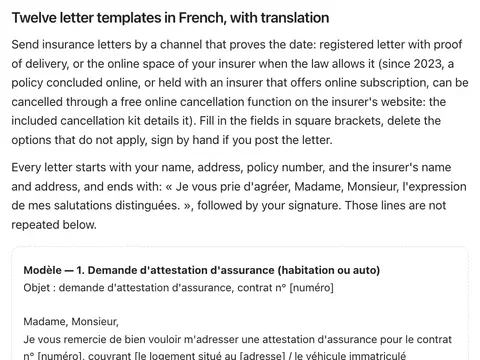
Complete pack · €89Insurance in France: the complete expat packTenant, owner, co-owner or holiday home: what to insure, how to let, how to claim, and the French letters you will need, translated
What’s in the pack — €89Insuring a flat in France is not the same exercise as insuring a house, and the difference is not size — it is ownership structure. Almost every French apartment block is a copropriété: a legal body of all the owners, run by a professional manager called the syndic, which owns the common parts and carries its own insurance policy. Your policy sits on top of that one. Knowing where the boundary runs is what stops you from paying twice, or from discovering a gap after a burst pipe.
Who insures what
The copropriété insures the common parts — structure, roof, staircase, lift, façade, shared pipework — and carries public liability for the building. Since the ALUR law of 2014 this cover is compulsory: the copropriété must be insured for liability, and so must every individual owner. The premium comes back to you through the quarterly service charges (appels de fonds), not through a separate bill.
You insure your own flat: the private parts, your contents, your liability towards neighbours and towards the copropriété. Which product depends on your status. A tenant must hold cover for risques locatifs and produce the certificate every year — our tenant insurance guide covers that, and the furnished rental guide the specifics of meublé lets. An owner-occupier is legally required only to hold liability cover, but in practice takes a full multirisque habitation, as described in our home insurance guide. A landlord who rents the flat out needs PNO cover — see the landlord guide — because the tenant’s policy protects the tenant, not the owner’s walls during a void period.
Water damage between flats: the claim that defines apartment living
Escape of water is by a wide margin the most frequent apartment claim in France, and it is also the one with the most confusing paperwork, because three parties are usually involved: the flat where the leak started, the flat below, and the copropriété. France solved the sorting problem with an inter-insurer agreement, the IRSI convention, which applies to water damage and fire claims up to €5,000 excluding VAT in a building. Under it, a single insurer — usually the occupant’s — takes charge of the survey and the settlement of each damaged flat, and the insurers sort out who ultimately pays between themselves afterwards. The practical consequence for you is simple: declare the claim to your insurer within five working days, even if you are certain the leak came from upstairs. The French mechanics are set out in our French-language guides on dégât des eaux and the IRSI convention.
What the building policy will not do for you
Four gaps recur. Your contents are never covered by the copropriété policy — furniture, electronics, bicycles in the cellar, everything you own. Your fitted improvements (embellissements: kitchen, parquet, bathroom you installed) are private parts and belong on your policy, at a realistic value. Theft from your flat is yours alone, with the usual French conditions about forced entry and, above a certain contents ceiling, approved locks. And your liability towards the neighbour whose ceiling you ruined is yours — the general principles are in our liability insurance guide.
What it costs and what moves the price
Indicatively €8–25 per month in 2026 for a typical two- or three-room flat, which is generally less than a house: no roof of your own, no garden, no swimming pool, and a shared structure already insured elsewhere. The premium is driven by the number of pièces principales (French insurers count rooms, not square metres, for the base tariff), the contents value you declare, the town, the floor you live on (ground-floor flats pay more for theft, top floors more for water ingress), and the options you add. These are market ranges, not quoted tariffs.
Practical points for newcomers
Three habits save trouble. Ask the syndic for the building’s policy summary when you move in: it tells you the deductible applied to common-part claims and whether the copropriété insured the private parts collectively, which some older buildings did. Keep the attestation d’assurance — the one-page certificate — where you can find it; the syndic, the landlord and the mortgage bank all ask for it annually. And remember that French home policies renew tacitly: after the first year you may cancel at any time with one month’s notice under the Hamon rules, which makes shopping around genuinely easy. The wider picture for arrivals is on our home insurance hub and in the overview of insurance in France.
Frequently asked questions
Is apartment insurance compulsory in France?
For tenants, yes — cover against risques locatifs is a legal obligation and the landlord may terminate the lease or take out a policy at your expense if you cannot produce a certificate. For owners in a copropriété, liability insurance is compulsory since the ALUR law; full multirisque cover is not, but going without it means paying for your own fire or water damage.
Am I already covered by the building’s insurance?
Only for the common parts and the copropriété’s own liability. Nothing inside your front door — contents, fitted kitchen, your liability to the flat below — is covered by it. Assuming otherwise is the single most common mistake made by foreign owners of French flats.
My neighbour’s leak damaged my flat. Who do I call?
Your own insurer, within five working days, with photographs and a rough estimate. Under the IRSI convention your insurer handles the survey and the settlement for claims up to €5,000 excluding VAT and then recovers from the other insurer. Do not wait for the neighbour to act, and do not start repairs before the survey unless it is an emergency to stop the leak.
Can I insure a French flat if I live abroad?
Yes. Insurers underwrite the address of the property, not your tax residence. Non-resident owners take either a second-home policy if they use the flat themselves — see the holiday home guide — or PNO cover if it is let. Declare how many weeks a year the flat stands empty: unoccupancy clauses are the detail that decides a burglary claim.
Sources
Updated 24 August 2026.
More expat guides: The French no-claims bonus (bonus-malus) explained · Student insurance in France: the three certificates you will be asked for · Cancelling an insurance policy in France · Breakdown cover in France: it is already in your car policy · all guides.